Type “cosmetic surgery courses” into Google and you’ll get a mixed bag of results, some genuinely about surgical training, plenty about Botox and fillers, and a few institutes that blur the line on purpose because it’s good for their ad spend. That blur causes real confusion, and honestly, it sends a lot of people down the wrong training path before they even realize it.
So let’s untangle it properly. This is what cosmetic surgery courses actually involve, why most people searching that phrase are really after something else, and what your actual options look like depending on what you want to end up doing.
Training as a doctor? See our 5-day invasive aesthetics course, the 2026 course fees and the 2026 training calendar.
What Cosmetic Surgery Courses Actually Involve
Cosmetic surgery, in its true clinical sense, means operative procedures, facelifts, rhinoplasty, liposuction, breast augmentation, tummy tucks. These are performed in an operating theatre, under anesthesia, by a qualified surgeon.
Getting there isn’t a short course. It typically means:
- Completing MBBS
- Specializing through a surgical residency (often plastic surgery or ENT/head-and-neck surgery pathways)
- Additional fellowship training specifically in cosmetic or plastic surgery
- Years of supervised operative practice before you’re independently performing procedures
There’s no legitimate weekend workshop or few-week diploma that turns someone into a cosmetic surgeon. If a course is promising that, that’s worth being skeptical of.
So Why Are So Many People Searching "Cosmetic Surgery Courses"?
Because in everyday conversation, “cosmetic” gets used loosely. Someone wanting to learn Botox, fillers, or skin treatments often types “cosmetic surgery course” without meaning actual surgery, they mean the broader world of appearance-enhancing procedures, most of which today are non-surgical.
And that’s genuinely good news, because the non-surgical route is faster to enter, doesn’t require a surgical residency, and, thanks to how much patient demand has shifted toward “no downtime” treatments, is where most of the current clinical and business opportunity actually sits.
This falls under what’s properly called aesthetic medicine or aesthetic courses, and it splits into two categories.
Aesthetic Courses: Invasive vs. Non-Invasive
Invasive aesthetic procedures involve injectables, Botox, dermal fillers, lip enhancement. No scalpel, but you’re still working with needles and pharmacologically active substances, so training is restricted to MBBS doctors registered with PMDC/PMC.
Non-invasive aesthetic procedures work on the skin’s surface or upper layers, microneedling, chemical peels, skin boosters, and device-based treatments like HIFU skin tightening. These courses are generally more accessible, open to qualifying non-medical professionals as well as doctors.
Botox Injection Course: What's Actually Taught
Since it’s one of the most searched entry points into aesthetic medicine, it’s worth breaking down properly. A legitimate Botox injection course covers:
- Facial muscle anatomy and injection site mapping
- Correct dosing and dilution
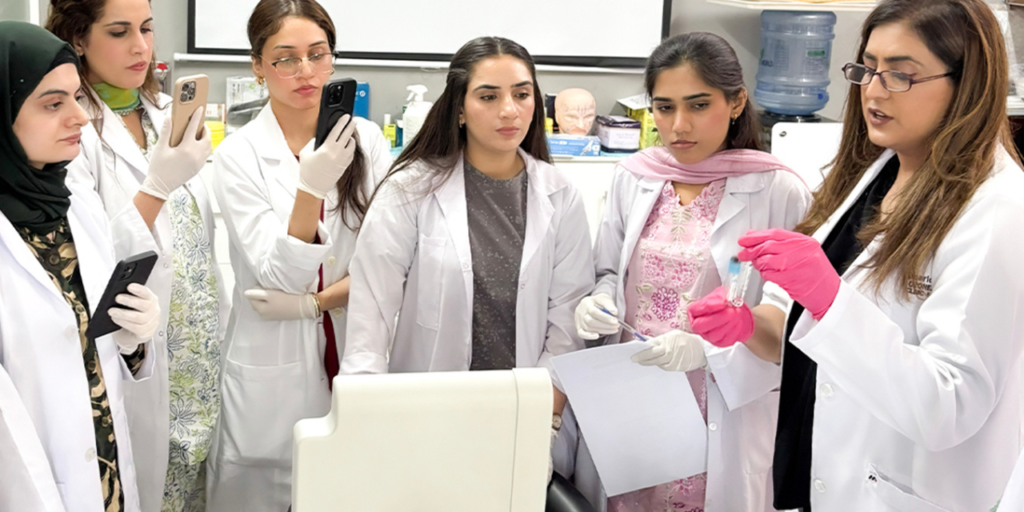
- Supervised practice on live patients, not just mannequins
- Recognizing and managing complications
- Aftercare and follow-up protocols
At London Aesthetics U.K. Training Institute, this is taught directly by Dr. Salma Merritt, Chief Medical Officer and UK Master Trainer with over 20 years of clinical experience, so the person teaching injection technique has actually spent decades doing it, not just presenting slides on it.
Aesthetic Laser Training Near Me: The Non-Invasive Route
If your search history includes “aesthetic laser training near me,” you’re likely after device-based treatments rather than injectables, HIFU, skin tightening, or similar technology-driven procedures. This is one of the fastest-growing corners of aesthetics right now, mainly because clients want visible, non-invasive results without recovery time.
London Aesthetics U.K. Training Institute runs hands-on, device-based training as part of its non-invasive course track, with locations in both Lahore and Islamabad, so you’re not restricted to a single city to get practical training time in.

Surgical vs. Non-Surgical: A Straight Comparison
Cosmetic Surgery | Aesthetic Medicine (Botox, Fillers, Non-Invasive) | |
Entry requirement | MBBS + surgical residency + fellowship | MBBS (invasive) or qualifying background (non-invasive) |
Training length | Several years | Weeks to a few months, depending on course depth |
Where it’s performed | Operating theatre | Clinic setting |
Downtime for patients | Often significant | Usually minimal to none |
Current market demand in Pakistan | Stable, specialized | Rapidly growing |
Entry barrier | Very high | Moderate, structured |
Neither path is “better” they solve different problems. But if you were searching for cosmetic surgery courses hoping for a faster, more accessible way into appearance-focused medicine, aesthetic training is almost certainly the answer you actually want.
Why Practitioners Choose London Aesthetics U.K. Training Institute
- UK-registered standing: the institute operates as a UK government-registered private limited company, which carries more international weight than a purely local certificate.
- Genuinely qualified leadership: Dr. Salma Merritt runs the training as Chief Medical Officer, not as a guest-lecture add-on.
- Structured eligibility: invasive courses for MBBS/PMDC-PMC doctors, non-invasive tracks for qualifying non-medical professionals, keeping training levels consistent.
- Two city locations: Lahore and Islamabad, so you’re not forced to relocate for training.
- A path after certification: a 1 to 6-month fellowship gives graduates supervised, real-patient experience before they’re working independently.
Who's Eligible for What
- Botox, dermal fillers (invasive): MBBS doctors registered with PMDC/PMC
- Microneedling, peels, device-based/non-invasive treatments: Qualifying non-medical professionals
- Advanced Dermatology Diploma & regenerative wellness: Eligibility assessed individually, confirm with admissions
Frequently Asked Questions
Are cosmetic surgery courses the same as aesthetic courses?
- No. Cosmetic surgery involves operative procedures performed by surgeons after years of surgical residency. Aesthetic courses cover non-surgical treatments like Botox, fillers, and skin treatments, and take considerably less time to complete.
Can I become a cosmetic surgeon through a short course?
- No legitimate short course qualifies someone to perform surgical procedures. Becoming a cosmetic surgeon requires MBBS, surgical residency, and further specialized fellowship training
Who can enroll in a Botox injection course?
Botox and other injectable courses are generally restricted to MBBS doctors registered with PMDC or PMC, due to the medical risk involved in administering injectables.
Where can I find aesthetic laser training if I'm not in Lahore?
- London Aesthetics U.K. Training Institute offers non-invasive, device-based training in both Lahore and Islamabad, so practitioners in either city can access hands-on practice locally.
Is non-surgical aesthetic training a good career alternative to cosmetic surgery?
- For most people, yes. It has a lower entry barrier, shorter training time, and strong current market demand, making it a practical path into appearance-focused medicine without a surgical residency.
