FUE, FUT, DHI and Sapphire FUE are the four names patients bring to every hair transplant consultation, and the four techniques doctors most often ask us about before they train. They all move healthy follicles from the donor area to thinning areas, but they differ in how grafts are harvested, how they are implanted, how the donor area heals and how long the procedure takes. This guide explains each technique from a doctor’s point of view.
FUE vs FUT vs DHI vs Sapphire FUE at a Glance
| Technique | How grafts are harvested | How grafts are implanted | Donor scar | Best suited to |
|---|---|---|---|---|
| FUT (strip) | A strip of scalp is removed and dissected into grafts | Into pre-made recipient sites | A fine linear scar | Large sessions where the patient keeps longer hair |
| FUE | Individual follicular units punched out one by one | Into pre-made recipient sites | Tiny dot scars spread over the donor area | Most patients, especially those who wear hair short |
| Sapphire FUE | Same as FUE | Into recipient sites made with sapphire blades | Same as FUE | Dense packing with small, precise incisions |
| DHI | Same as FUE | Directly with an implanter pen, without separate sites | Same as FUE | Hairline work and adding density between existing hair |
FUT (Follicular Unit Transplantation)
In FUT, the surgeon removes a thin strip of skin from the back of the scalp, closes the wound, and the team dissects the strip into individual follicular units under magnification. The grafts are then placed into recipient sites.
- Advantages: large numbers of grafts in one session, grafts kept intact with surrounding tissue, and no need to shave the donor area.
- Limitations: a linear scar, more post-operative discomfort and a longer recovery for the donor area.
FUE (Follicular Unit Extraction)
FUE harvests each follicular unit individually with a small punch, usually 0.7 to 1.0 mm, using a manual or motorised device. Grafts are then implanted into recipient sites created with blades or needles. FUE is now the most commonly requested technique because it avoids a linear scar and recovery is quicker.
- Advantages: no linear scar, faster healing and suits patients who keep their hair short.
- Limitations: the donor area is usually shaved, the procedure is longer, and poor punch technique causes transection (cutting) of follicles.
Sapphire FUE
Sapphire FUE is FUE with one difference: the recipient sites are made with sapphire-tipped blades instead of steel. Supporters say the smooth, sharp blades allow smaller, cleaner incisions and denser packing. Extraction is exactly the same as standard FUE, so it is best described as a refinement of FUE rather than a separate technique.
DHI (Direct Hair Implantation)
DHI also uses FUE extraction, but grafts are loaded into a pen-shaped implanter (often called a Choi pen) and placed directly into the scalp, creating the site and implanting the graft in one step. This gives close control over angle, direction and depth.
- Advantages: precise angle control, useful for hairlines and for adding density between existing hairs without shaving the recipient area.
- Limitations: slower, needs more trained staff and more implanter pens, and is usually priced higher than standard FUE.
Which Technique Should a Doctor Learn First?
Most doctors start with FUE, because it is the technique patients ask for most and its extraction skill is shared by Sapphire FUE and DHI. Once you can extract cleanly with low transection, implantation with blades or a DHI pen is a smaller step. Understanding FUT is still valuable, because some patients need a large number of grafts and strip harvesting remains an option for them.
Whatever the technique, results depend far more on patient selection, hairline design, graft handling and the surgeon’s skill than on the name of the method.
How Our Hair Transplant Course Teaches These Techniques
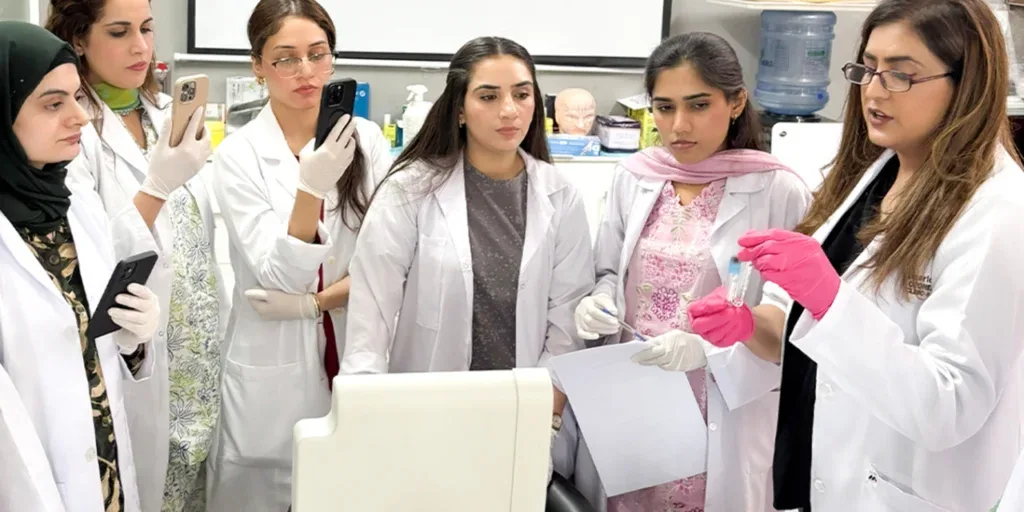
Our 2-day hair transplant course in Pakistan covers FUE, FUT and DHI. Day 1 covers assessment, hairline design, graft calculation and anaesthesia. On Day 2 every doctor performs FUE extraction, recipient site creation and graft implantation on a live patient under supervision. PRP is taught as a supporting treatment for hair loss; for full PRP training see our PRP course.
Frequently Asked Questions
Which is better, FUE or FUT?
Neither is better for every patient. FUE avoids a linear scar and heals faster, so most patients prefer it. FUT can harvest a large number of grafts in one session and leaves the donor area unshaved, which suits some patients.
Is DHI better than FUE?
DHI uses the same extraction as FUE but implants grafts with a pen, giving more control over angle and depth. It is useful for hairlines and adding density between existing hair, but it is slower and usually costs more. Results depend mainly on the surgeon’s skill.
What is Sapphire FUE?
Sapphire FUE is standard FUE extraction with recipient sites made using sapphire-tipped blades instead of steel ones, which may allow smaller, cleaner incisions.
Which technique should doctors learn first?
Most doctors start with FUE because it is the most requested technique and its extraction skill is shared with Sapphire FUE and DHI.
Does your hair transplant course teach all these techniques?
Our 2-day course covers FUE, FUT and DHI, with live-patient practice of FUE extraction, recipient site creation and implantation.